
The Jar Needs a Keeper
On frozen specimens, personal brands, and the people who notice when something has changed

Lead With Alignment is an entirely reader-supported publication that applies social science research to the cultural, political, and technological issues shaping our world today. If you read it and value the labor that goes into it, consider supporting it by liking or sharing this essay, becoming a paid subscriber, or buying me a coffee! Thank you!
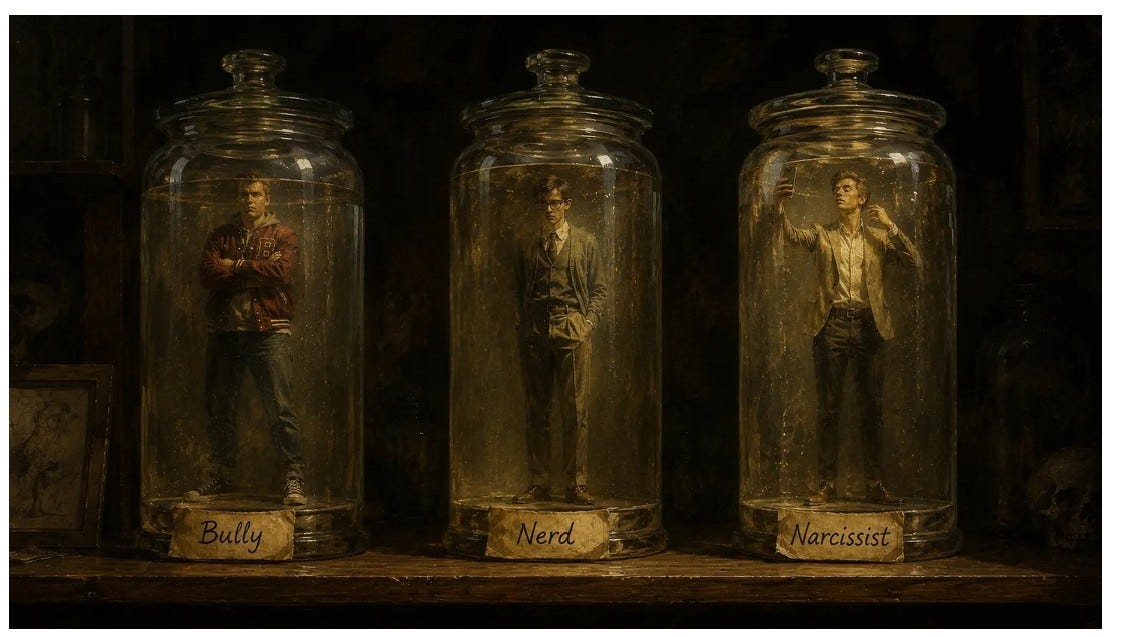
Aidan McCullen hooked me with the reference to Steinbeck’s “Pickled Fish Problem.” Most development essays in this territory reach for the idea that people can change, but rarely make a case worth sitting with. McCullen’s visceral images illustrate how we preserve people at their worst moments and mistake the specimen for the whole animal. The Steinbeck metaphor of a pickled fish holds one kind of truth—shape, size, the fact of capture…stink—and conceals everything the living creature once was: texture, motion, the light and life force that moved through it. We do this to people constantly, and most of us have done it without much examination.

I read the piece and immediately wondered how many jars have my name on the label.
The comment that landed wrong where I missed a social cue in a faceless, virtual meeting. The moment I stopped waiting for a manager to invest in my development and invested in my own, it looked, from the outside, like not waiting for my turn, but, from the inside, was a form of personal and professional survival. Who knows how many people sealed that version of me in glass and moved on. What I do know is that the specimen they preserved was real. It was just not whole.
But here is where I want to push on the essay’s framing, because it makes the jar sound like the problem when the deeper issue is who put me there, and holds the lid?
McCullen is right that struggle moves people. What he doesn’t fully reckon with is that movement is not inherently toward growth. Fear can calcify cruelty. Insecurity practiced long enough can become a personality trait. The Jobs story is compelling precisely because it is unusual; most people who wound others at NeXT-scale did not go on to develop genuine empathy in their fifties. They just moved to a new organization and found new people to wound. The jar outlasted the fish because, in those cases, the fish maybe hadn’t changed.
The question the essay leaves open is an important one: how do you tell the difference between a jar that should be updated and one that is doing exactly what it should?
Part of the answer, I think, is that you rarely make that determination alone. The people who opened my jars—a partner whose patience was structural rather than sentimental, friends who had known me long enough to hold the longer arc—were not naive about who I had been. They were precise about it. They didn’t excuse the specimen’s actions; they kept their hands on the glass and waited to see what moved. That is different from extending the unconditional benefit of the doubt, which is not generosity but risk transfer.
We are in a cultural moment right now that makes this harder than it should be. The conditions that allow people to change (e.g., friction, honest feedback, and enough psychological safety to acknowledge a wrong turn) are being slowly dismantled in favor of frictionless self-presentation. We curate the version of ourselves that we want preserved—those perfect Christmases, the happy graduations, etc. The jar becomes our personal brand. But when everything is managed at the surface, there is no specimen at all, just packaging.
Freedom to actualize as an adult, to actually become something other than your worst or most frozen moment, requires the friction of being deeply known. Not performed. Not managed. Known. That takes people willing to stay close enough to notice the difference, and it takes environments that reward the discomfort of revision over the comfort of a fixed story.
The pickled fish problem is real, but the solution isn’t to empty all the jars. It’s to find the people, the keepers, who will hold your jar up to the light, notice when something has changed, and say so—without pretending the earlier specimen never existed.
Subscribe to Lead With Alignment
By Christine Haskell | Where people come to think.
Thoughts on our fragility as we cling to this big, beautiful rock hurtling through space.