
Criticism, Intellectual Contempt, and Taste
And It’s Not AI’s Fault You Can’t Tell the Difference

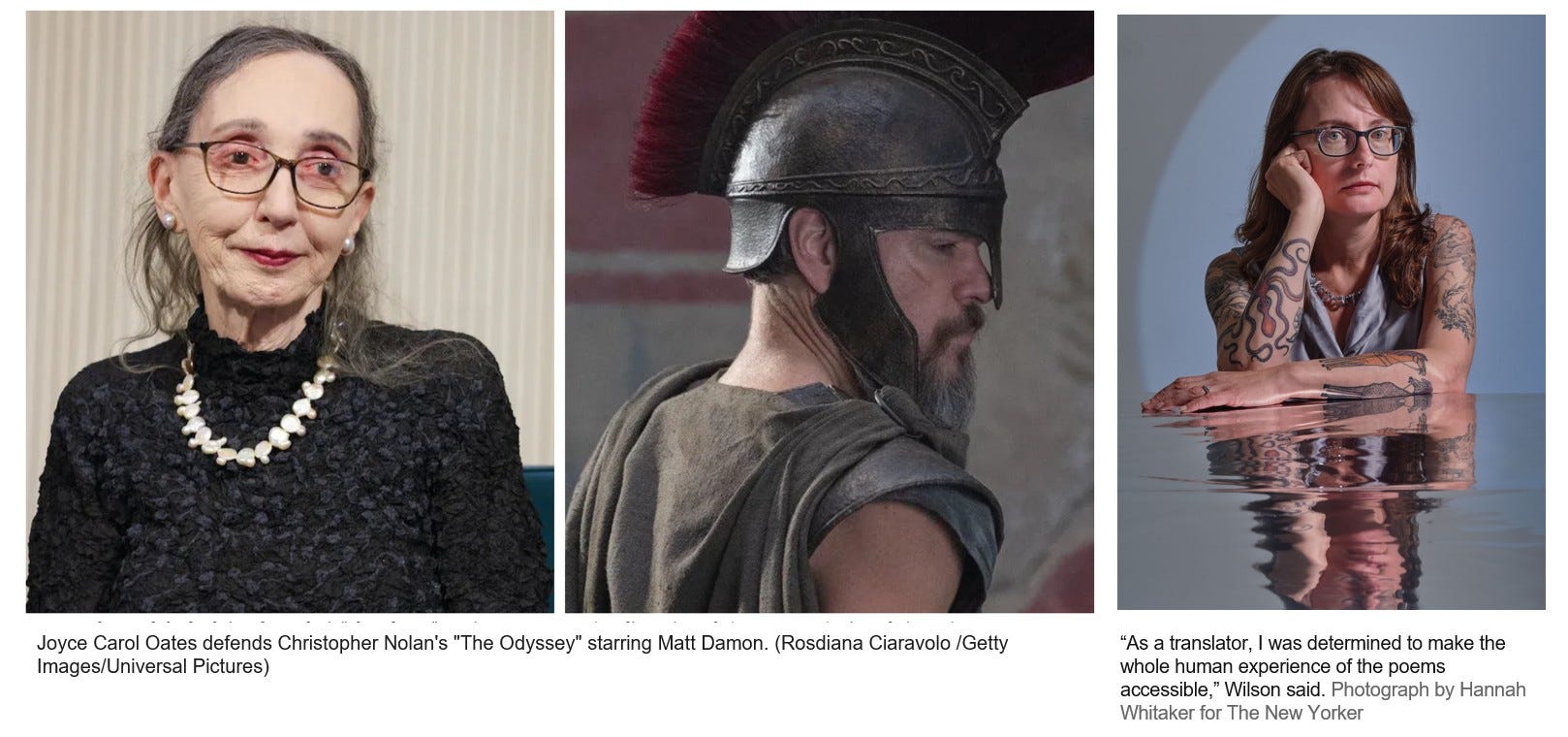
Image Credit: to the respective owners
Lead With Alignment is an entirely reader-supported publication that applies social science research to the cultural, political, and technological issues shaping our world today. If you read it and value the labor that goes into it, consider supporting it by liking or sharing this essay, becoming a paid subscriber, or buying me a coffee! Thank you!
Joyce Carol Oates was right to object to Emily Wilson’s review of Christopher Nolan’s The Odyssey. She didn’t write it because Nolan needed protection or rescuing, and Wilson didn’t lack the authority to criticize his adaptation. Oates wrote it because she has the authority, and much of her criticism appears serious. We don’t see that much anymore, so I wanted to call out the distinction because it was such a shining example.
Oates’s intervention was appropriate because Wilson’s review, and the media celebration that followed, collapsed three different things into one performance: criticism, intellectual contempt, and taste.
We increasingly treat these as interchangeable. They are not.
Criticism explains why a work succeeds or fails according to standards that other people can examine. Intellectual contempt uses intelligence, expertise, or status to establish the inferiority of the person who made the work or of those who might admire it. Taste is the realm of preference: what moves us, irritates us, bores us, attracts us, or leaves us cold.
A person can possess excellent taste and make a poor argument. A person can offer strong criticism of something she dislikes. A person can also disguise contempt as criticism by surrounding an insult with enough expertise to make it appear analytical.
Wilson’s review appears to contain all three. Oates’s achievement was to recognize that they should not be treated as equivalent.
Her objections to Nolan’s film are substantive. She argues that it reduces the moral, political, and psychological complexity of Homer’s poem. She objects to Nolan’s treatment of Odysseus, to the motivations of the characters, and to the film’s account of war, memory, time, responsibility, and homecoming. Those are legitimate subjects of criticism. They identify what Wilson believes the adaptation attempted, what it failed to understand, and what was lost in the transfer from poem to screen.
Then there is taste. Wilson dislikes Nolan’s characteristic grandiosity. She finds his narrative devices gimmicky. She thinks the food looks horrible and notes the absence of sex scenes. These observations may help convey her experience of the film, but they do not all carry the same argumentative weight. Some tell us more about Wilson’s sensibility than about the quality of the adaptation.
Taste matters. Critics are not machines for applying neutral standards. Their responses are shaped by temperament, aesthetic preference, disciplinary formation, and prior commitments. But taste becomes misleading when it presents itself as proof. “I found this superficial” may open an argument. It does not complete one.
Finally, there is contempt: “I would be ashamed to have written any part of this script.”
That sentence does not illuminate Nolan’s interpretation of Homer. It does not help the reader understand the film’s structure, moral failures, or aesthetic limitations. It establishes rank. It tells us that the work is not merely unsuccessful but beneath the dignity of a serious writer—and that the critic occupies the superior position from which such shame may be assigned.
This is the point Oates challenged.
She did not simply defend Nolan’s film. In fact, she expressed preferences for other treatments of The Odyssey. Her intervention was therefore more interesting than the media framing of two famous writers “sparring” over a blockbuster. Oates was defending a norm: intellectual authority does not exempt a person from the obligation to distinguish judgment from humiliation.
That stand is appropriate in three particular ways.
A generational correction
There is a generational quality to Oates’s response, though it would be too easy to describe it as an older woman demanding more civility from a younger one.
The more important distinction concerns the use of stature. Oates comes from a literary culture in which public intellectuals certainly could be cruel, territorial, and dismissive. Earlier generations did not lack contempt. But they were also formed within institutions that at least claimed to distinguish argument from performance, criticism from publicity, and authority from celebrity.
The contemporary media environment rewards their collapse. Today, the most portable part of a review is rarely its most careful argument. It is the sentence that can be detached, screenshotted, quoted in a headline, and circulated as evidence that someone has been destroyed. The critic’s intelligence is measured by the elegance of the blow. The audience is invited to admire not what the criticism reveals, but how efficiently it humiliates.
Wilson’s sentence about being ashamed was built for this (social, viral, online) environment, whether she intended it that way or not. It allowed people who had not read Homer, seen Nolan’s film, or considered the difficulties of adaptation to participate in the pleasure of dismissal.
Oates interrupted that pleasure. Her generational claim is not that elders deserve deference. It is that seniority should produce greater responsibility for the effects of one’s judgments. The more authority a person possesses, the less defensible it becomes to confuse disdain with discernment.
A senior scholar or writer should be capable of saying, “This interpretation fails, and here is why,” without implying that only an inferior mind could have produced or appreciated it.
That is not politeness. It is discipline. It is also why Oates’s intervention struck me so forcefully. I admired her writing when I first fell in love with literature in high school; here, I admired her willingness to use that formidable pen to defend a standard rather than merely a side.
A scholarly correction
Oates’s objection also matters from a scholarly point of view because Wilson is not only a reviewer. She is a translator whose own celebrated version of The Odyssey necessarily interprets the text.
Translation is not the transparent transfer of meaning from one language to another. It involves decisions about tone, rhythm, vocabulary, characterization, ambiguity, cultural distance, and audience. Wilson’s rendering of Odysseus as “a complicated man” is not simply Homer delivered without mediation. It is a choice—an illuminating and influential one, but a choice nonetheless.
Nolan’s film is also an interpretation, made through a different medium and under different constraints. It can be a bad interpretation. It can simplify what should remain difficult, sentimentalize what should remain morally unstable, or replace psychological and political complexity with spectacle. Scholarly expertise is indispensable for identifying those losses.
But expertise does not establish ownership. A translator may explain where an adaptation departs from a text. She may show what the adaptation misunderstands. She may argue that its departures are artistically or ethically disastrous. What she cannot reasonably claim is that her own interpretive relationship to the source is categorically different from all others, as though she merely serves the text while the filmmaker presumptuously distorts it.
All interpretation selects, emphasizes, suppresses, and constructs. The scholarly obligation is therefore not to suspend judgment. It is to make judgment accountable. What standards are being used? What evidence supports them? What alternative interpretation is being rejected? What is gained or lost by the critic’s own position?
Contempt evades those responsibilities because it closes the inquiry. Shame is not a standard. Superiority is not evidence.
Oates was right to insist that someone “beholden to a text” should understand the humility demanded by interpretation. That does not mean all interpretations are equally good. It means no interpreter escapes the condition of interpretation.
A media correction
Oates also used the appropriate medium for her objection.
Wilson published a substantial review. But the review did not remain a substantial review. It became a collection of “burns.” Entertainment coverage transformed an argument about Homer, adaptation, gender, war, character, and narrative structure into a spectacle of intellectual aggression.
The media did not invent Wilson’s words. But it selected the language best suited to circulation and treated severity as the story.
Oates answered in the same public arena where that reduction was taking place. She did not demand that Wilson’s review be withdrawn. She did not appeal to an employer or institution. She did not argue that Wilson lacked the right to speak. She responded to public criticism with public criticism.
That is an appropriate use of media: not to suppress a judgment, but to challenge the norms governing how that judgment is received.
Oates’s own response was not beyond criticism. Her comparison between Wilson’s language and MAGA rhetoric was unnecessarily inflammatory and made it easier for the media to produce another adversarial headline. Her suggestion that Wilson had benefited commercially from Nolan’s film was also weak. Increased book sales do not obligate a scholar to express gratitude toward an adaptation she dislikes.
But those flaws do not invalidate the central point. Public discourse needs people willing to say that a clever insult is not necessarily a strong argument, that expertise does not confer immunity from arrogance, and that a critic’s severity should not be confused with courage.
And no, this is not AI’s fault
It would be tempting to blame artificial intelligence for our inability to maintain the distinctions between criticism, intellectual contempt, and taste. AI can certainly worsen the problem. It can generate polished takedowns without conviction, manufacture analytical categories after the fact, and produce the appearance of judgment without the intellectual labor from which judgment should emerge. It can flatten criticism into formula: begin with a concession, identify three failures, insert a memorable condemnation, and conclude with moral significance.
But AI did not teach us to confuse contempt with criticism. We did that through decades of media incentives that reward conflict over inquiry, confidence over qualification, and humiliation over interpretation. We learned to call personal preference an “objective” standard. We learned to regard cruelty as evidence that the speaker cannot be intimidated. We learned to consume criticism as a spectator sport in which the point is not to understand the work but to watch someone lose.
AI entered a culture already trained to reward the “sickest burn.” The problem is not that machines have made distinctions impossible. The problem is that many people no longer find the distinctions useful. Criticism takes time. Taste requires self-knowledge. Recognizing contempt requires us to question people whose conclusions we may otherwise share. Mature judgment requires us to remain in that friction rather than rushing toward affiliation.
It is much easier to ask whose side we are on. Oates’s intervention was valuable because she refused that sorting mechanism. She could dislike aspects of Nolan’s adaptation and still object to Wilson’s posture. She could respect Wilson’s expertise without treating every sentence she wrote as an expression of scholarship. She could defend a powerful male director without suggesting that a woman critic should be silent or agreeable.
That is what mature judgment looks like. It separates the work from the person, the argument from the insult, the standard from the preference, and the critic’s authority from her appetite for dismissal.
Wilson may be right that Nolan’s Odyssey lacks the depth of Homer’s poem. Oates was right that intellectual contempt does not become criticism merely because an intellectual delivers it.
Audiences should still be able to tell the difference.
Subscribe to Lead With Alignment
By Christine Haskell | Where people come to think.
Thoughts on our fragility as we cling to this big, beautiful rock hurtling through space.